
Oscilloscope music
Music with hidden images

I love Demo music, the tinny 8-bit tracks but I love even more the modernized versions with a more powerful base, something like:
But then again I also like pure experimental 8-bit music.
Some time ago, in 2015 I came across an interesting Kickstarter project. It used an oscilloscope to draw images which is not that new. People have been using oscilloscopes as screens ever since they were invented. The ability to precisely position x,y a glowing dot made it very useful. And as with every new technology, it’s been used for questionable things almost immediately.

In essence, old-fashioned Cathode Ray Tube Television sets are oscilloscopes and if you reconnect their deflection coils to the source you control you get an oscilloscope. Some of the tutorials you can check out on Instructables are by edwardcotad and by DWinker.
What caught my eye is not that images were drawn on the screen but that the images were the music.
Confusing, a little, but let me explain. Most audio signals are stereo signals meaning that they consist of left and right channels which in terms of math can be looked at X and Y axis where we plot the frequency and amplitude of signals on XY grid.
To play around with this you can use Two channels frequency generator, or a more “advanced” but prehistoric Heathcliff made by Patrick Kolla way back in 2001.
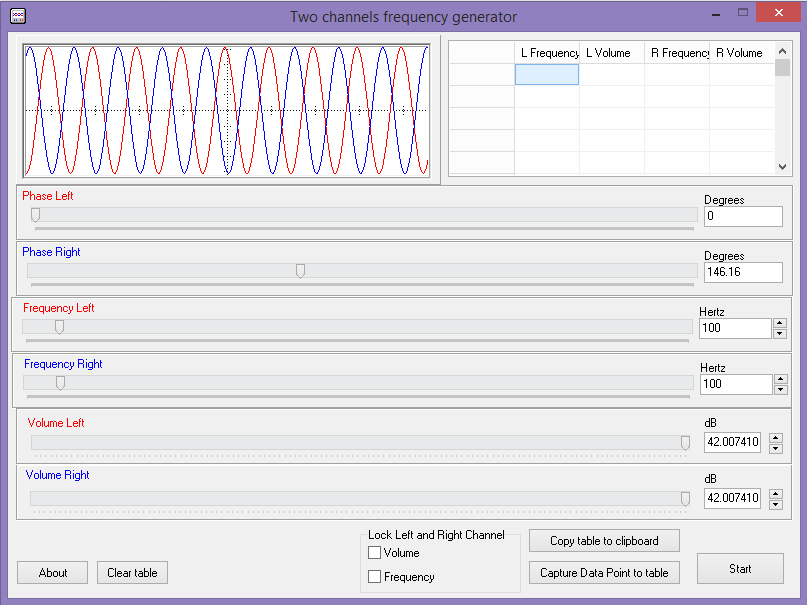
When playing with sine waves and their phases and frequencies you get a pattern known as the Lissajous pattern. It appears in the oscilloscope display when the frequencies of the signals are the same. When the phase shift is 90° or 270°, and both signals are the same frequency, a perfect circle is displayed. When the phase shift is 45°, the Lissajous pattern is an ellipse whose centerline slopes upward from left to right. When the phase shift to 180°, the Lissajous pattern is a straight line sloping down from left to right.
Oscilloscope music is a unique genre of music that utilizes the visual display of an oscilloscope to create a unique auditory and visual experience. This type of music often involves using electronic signals, such as those produced by synthesizers or other electronic instruments, to create patterns and shapes on the oscilloscope screen.
The most basic way to create an image on an oscilloscope is by using a single electronic signal. By adjusting the amplitude and frequency of the signal, the oscilloscope can display a single line or dot on the screen. By adjusting the position of the dot, a simple image can be created.
To create more complex images, multiple signals can be used. Different patterns and shapes can be created by superimposing various signals on top of one another. This is done by adjusting the phase and amplitude of each signal and combining them to create a more complex image.
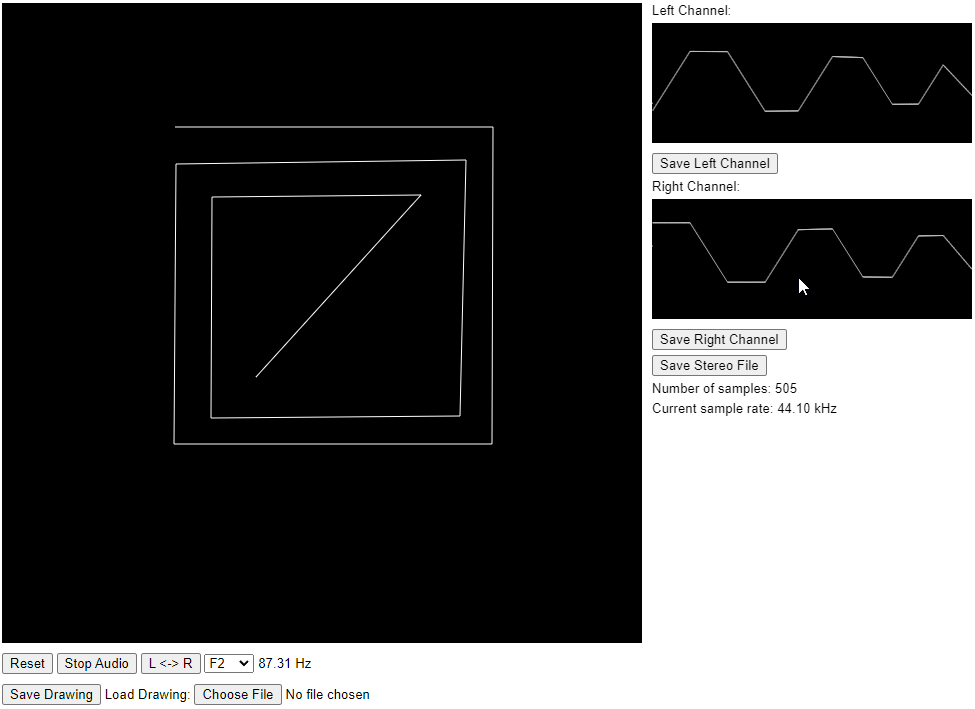
If you want to try to play around with some simple sound generation you can check out Oscilloscope Graphics Editor.
Just a quick warning, these sounds by themselves are pretty annoying and be sure to decrease your volume before proceeding.
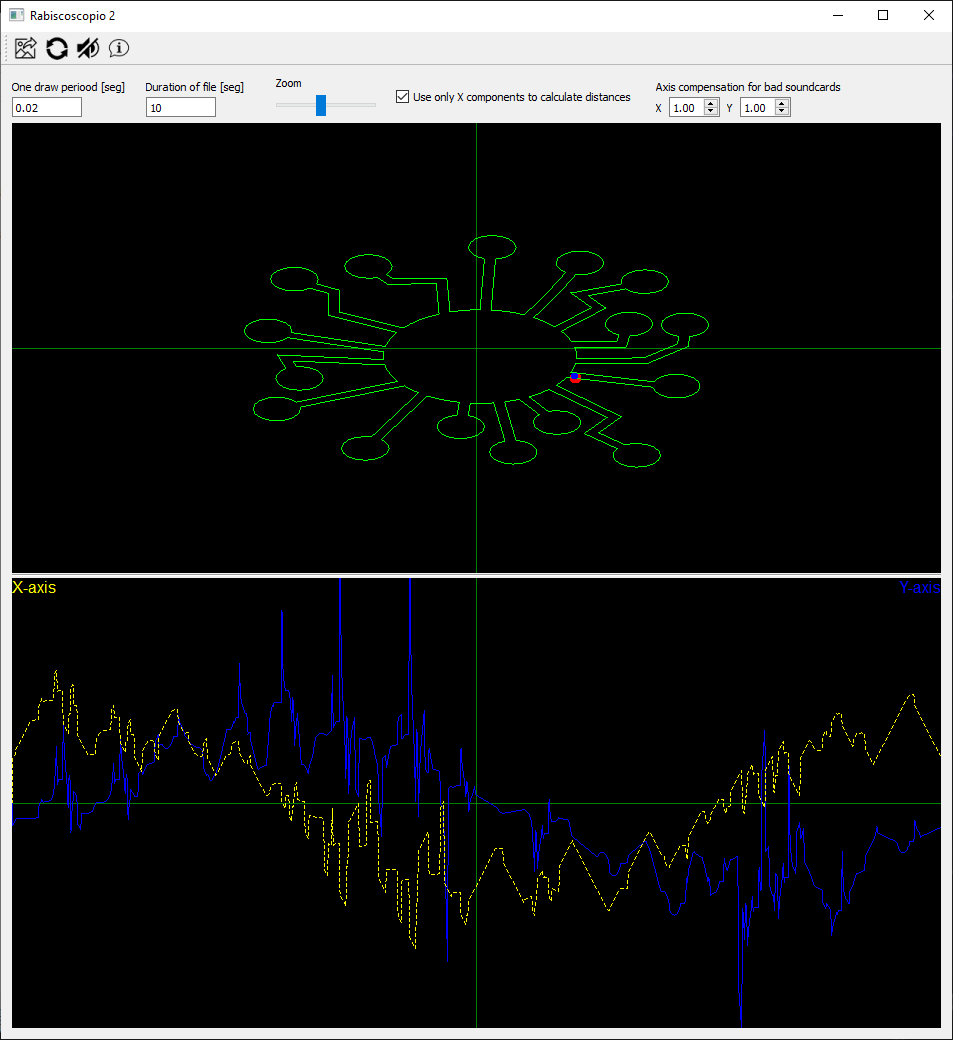
Rabiscoscopio is an open-source project that can read SVG and output a stereo signal that can draw a picture on an oscilloscope. Its last maintenance was some 7 years ago. So, don’t expect much.
There is also a recent Blender plugin made by Ilya Belikov. On his GitHub there is also an image and video python script converter to XY wav audio file alongside the blender plugin.
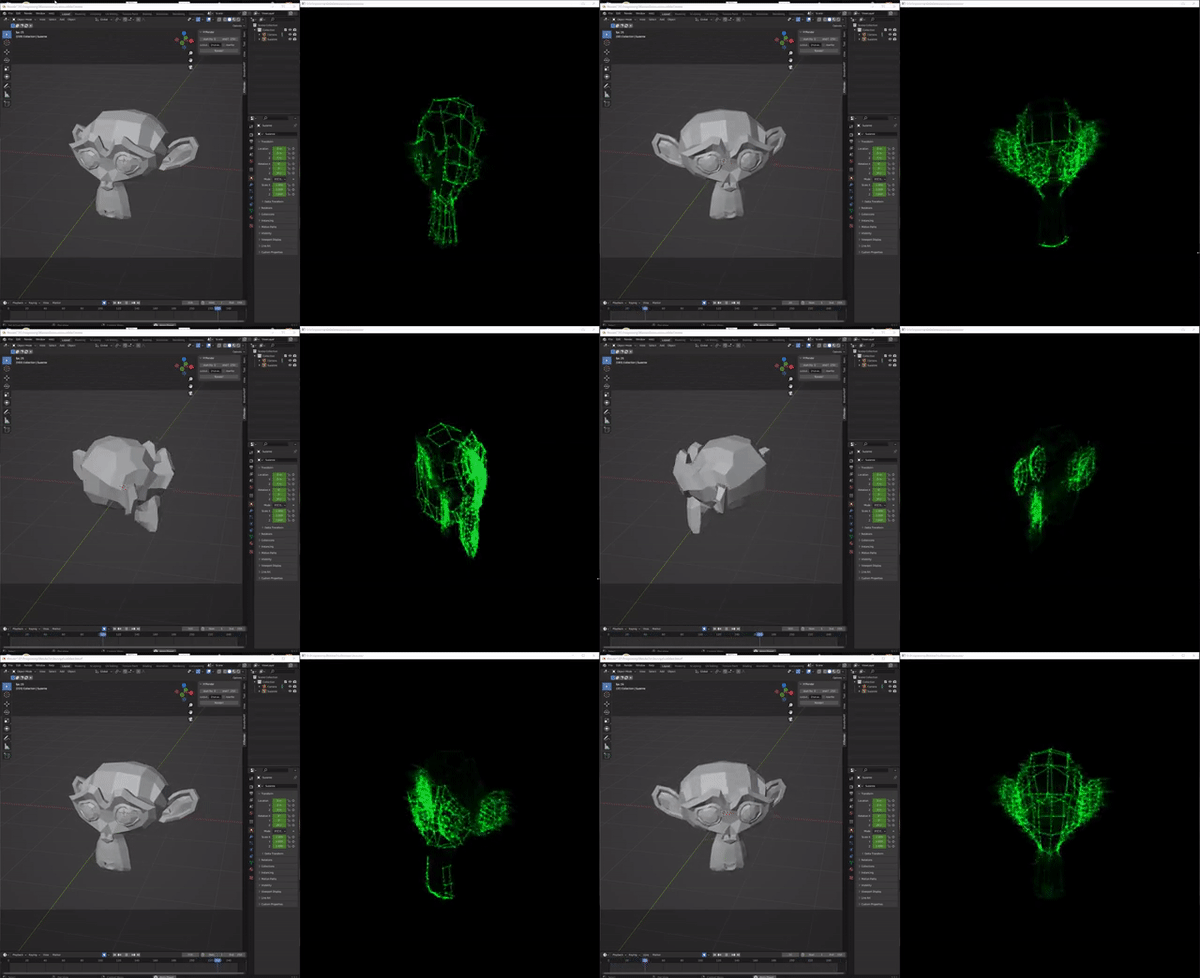
To test out the resulting wav file you can load it up into XYZ Oscilloscope which is an online app. If you wish to install a wav viewer to a desktop you can use Oscilloscope!. What is interesting is how Youtube video picture quality is different from downloaded audio files. The downloaded file is in mp3 format and that means compression. The original outputted video has clear lines while the compressed (mp3) is full of noise in the signal, which is not surprising but something to keep in mind if you want to keep your music-encoded images as clear as possible. Just leave them as wav of flac audio formats.

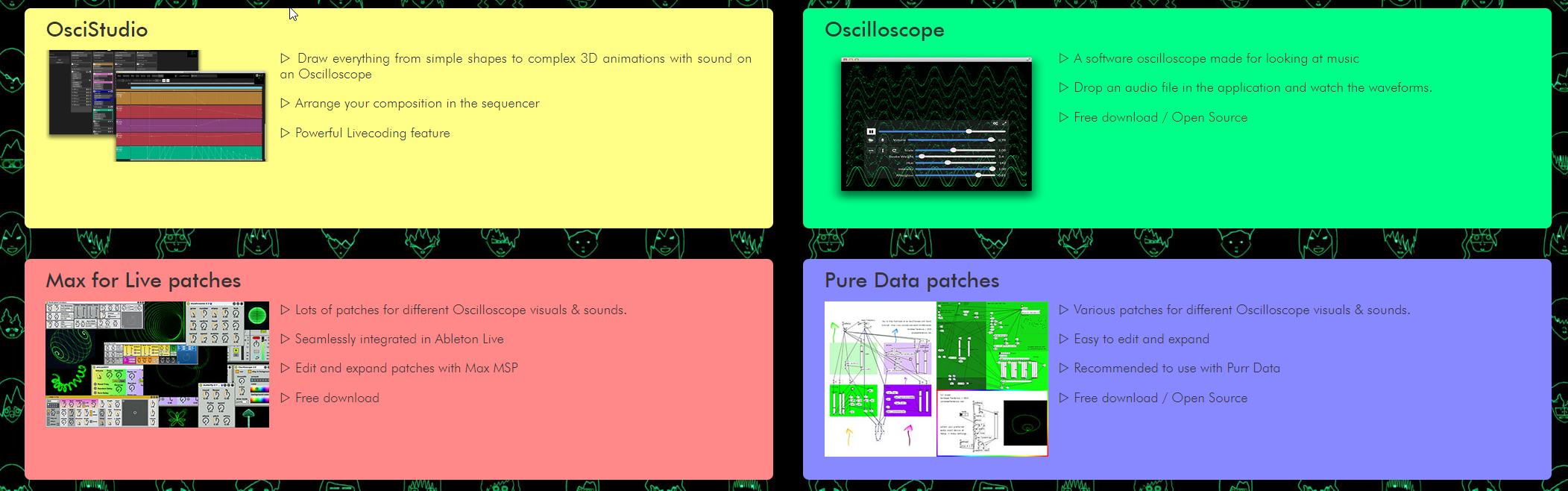
Or you can head over to oscilloscopemusic shop and get yourself a set of proper musician tools for creating visually stunning and sounding music. The same software Jerobeam Fenderson uses in creating his music.
So, now armed with this knowledge, not all weird-sounding music is just sound, it could contain an image of animation within its chirps and hisses and you can create your own music with hidden meaning.